

Neo-Impressionism formed as a counter-reaction to Impressionism and the freedom of the brushstroke. The intuitive methods of the Impressionists were formulated into a systematic by the following generation.
Artists such as Georges Seurat sought to scientifically substantiate and enhance what the Impressionists had developed in artistic practice. The Neo-Impressionists sought scientific foundations for their methods and thus dealt with the physiology of vision, with the problems of optics and the physical conditions of light and color analysis. With these approaches, they attempted to further theoretically grasp what had been empirically tested in Impressionism, in painting itself, and to place their work on a scientific level with the help of a new technique: Divisionism or Pointillism (1889-1910).
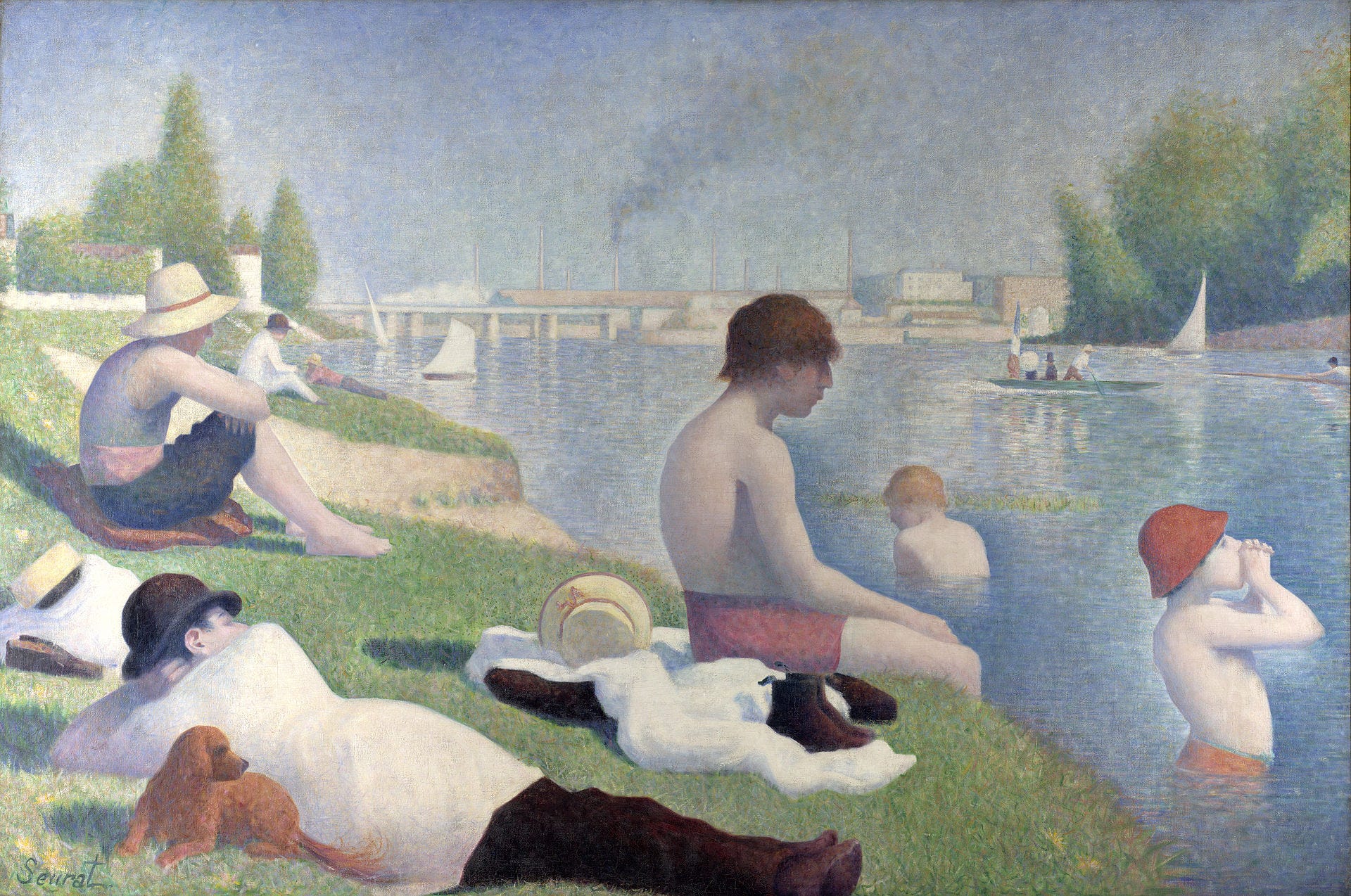
Pointillism as a still direction describes colored dots or dabs as a distinct and systematic way of applying color, replacing the instinctively applied and bold brushstrokes of Impressionism. There is an increase in color variety and effect through a dense juxtaposition of dots in the picture and so, also a removal of depicted bodies and objects from their usual form. The beginning of the detachment of color from the object - or, the development to modernism.
Nevertheless, one sometimes gets a rigid and "artificial" impression of Post-Impressionist painters through the narrow guidelines, which one had believed to have overcome after the overcoming of academically oriented painting or classicism by Impressionism.
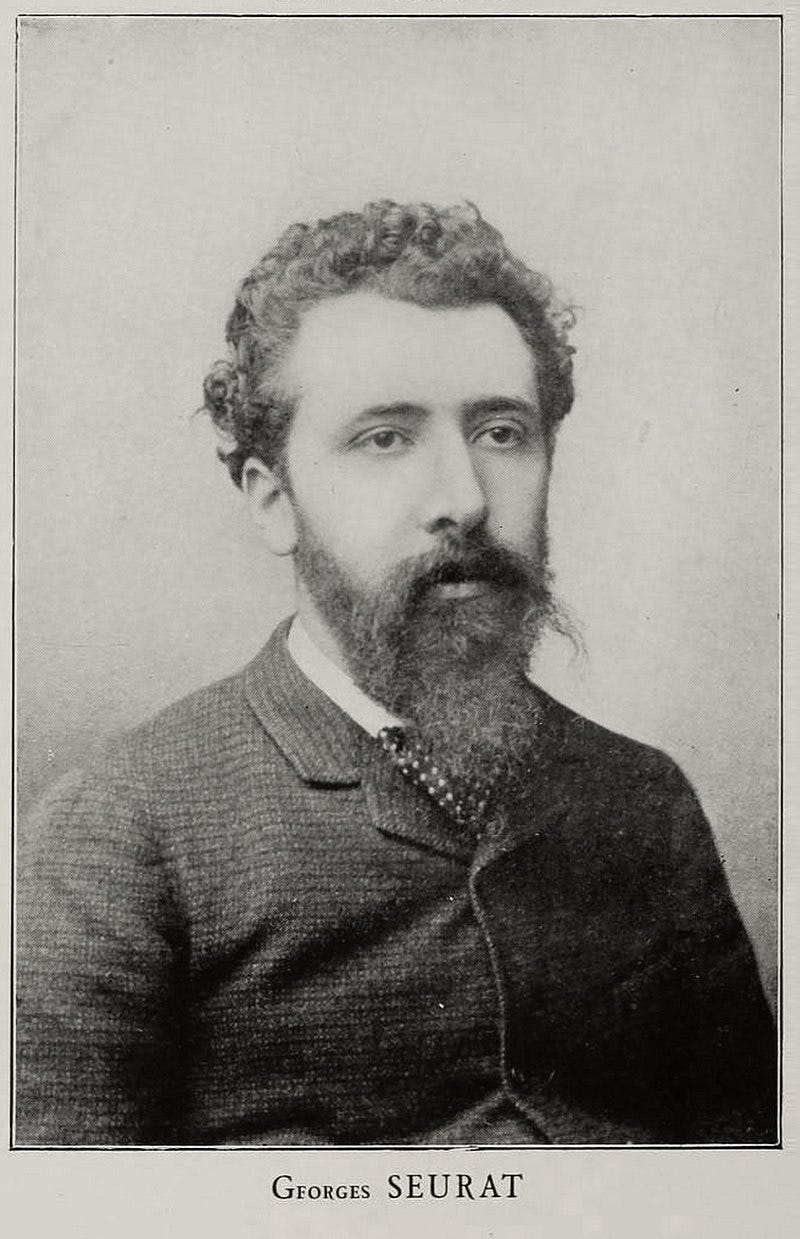
One of the founders and most important representatives of Post-Impressionism was Georges Seurat (1859-91). An admirer of natural sciences, he was particularly concerned with Chevreul's color wheel theory. He himself tried his own color-theoretical experiments with color mixtures and then with separate color dots. He worked according to a system of filling the canvas with color dots of minimal size in order to achieve that they mix in the eye of the viewer with the neighboring dots to form differentiated color perceptions. He worked exclusively with the pure spectral colors to achieve a "pure color value" and capture the light effects of nature with his specific application of color.
He was much concerned with the entertainment industry, new metropolitan leisure activities, and the encroachment of big cities on nature. Industrialization: the leisure, distance, pleasure, a distance from the troubles of everyday life are core elements of post-impressionist painting as well.
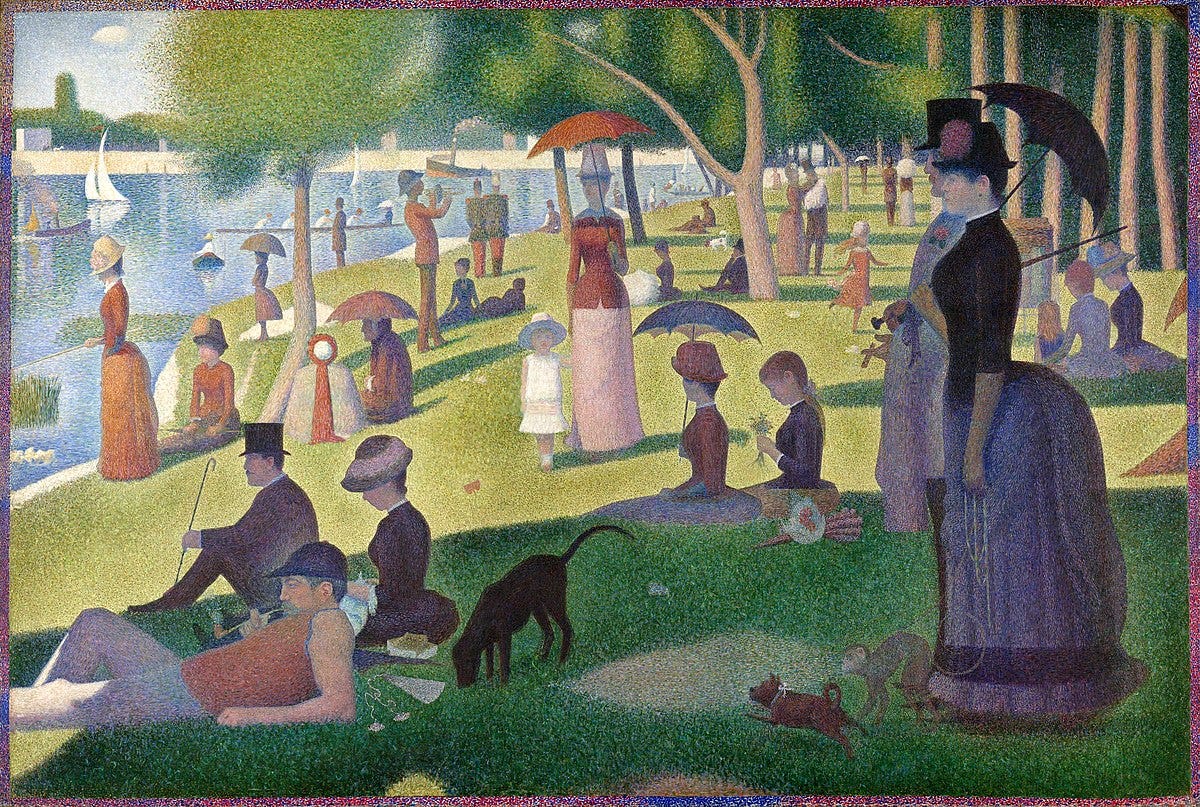
One of the most famous examples of this is certainly Seurat's A Sunday Afternoon on the isle of La Grande Jatte, which he painted between 1884-5.
The faces are expressionless and the totality of all the figures is a sign of monotony. There is a distance between the people: "Seurat {...} may be said to have reduced forms not to classicize or generalize {...} but to dehumanize, to transform human individuality into a critical index of social malaise" (Nochlin, The Politics of Vision. 1991, p.185).
In Seurat's work, people are reduced only to their form. Thus, the nanny in La Grande Jatte remains limited to the characteristics that mark her as a nanny. With his stylization of people, Seurat himself criticizes the beginning of modernity, life after industrialization. Man becomes more and more what he does for a living; the subject no longer counts for much without his recognizable role within production.
The pointillism of the painting also refers to the new modes of production of modernity. The mechanization is reflected in the painting of the points that appear the same, reminiscent of the mode of production produced by machines. The externals of the people, the image they represent, how they speak, that is what makes them (Cf. Nochlin 1991, p. 173).